The 1833 Slavery Abolition Act was a turning point in history
because it gradually emancipated and prohibited slavery in the
British Empire.
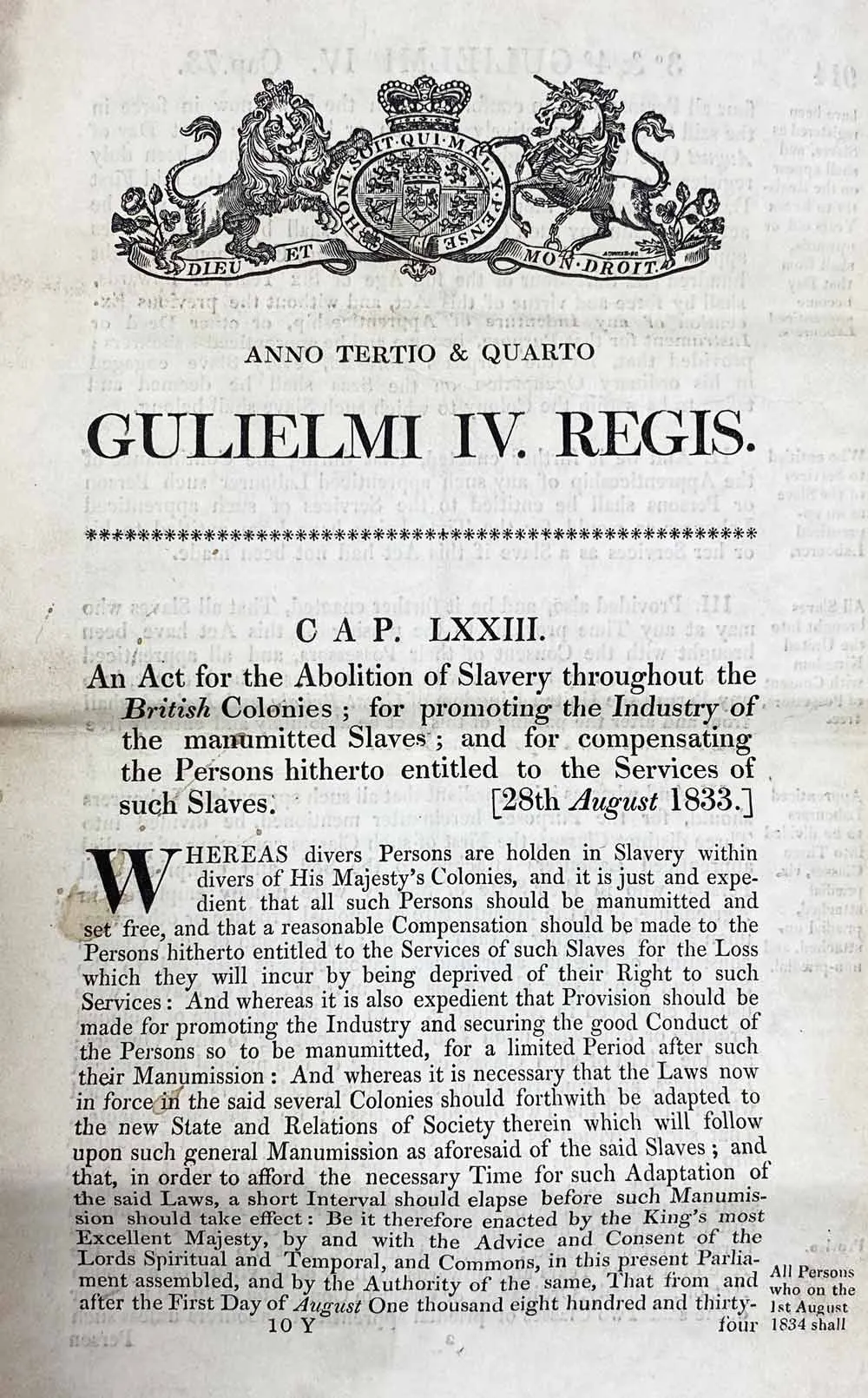
Image: (The Published
Act for the Abolition of Slavery throughout the British Colonies,
1833).
Abolition
The Turning Point
Image: The Published Act for the Abolition of Slavery throughout the British Colonies (The Published Act..., 1834).
Emancipation...
Image: (Eight hundred thousand slaves set free, 1849).
III
“That all Slaves...shall from and after the passing of this Act be absolutely and entirely free, to all Intents and Purposes whatsoever.”— Slavery Abolition Act ("Slavery Abolition Act, 1833", 1833).
XII
“Persons who on [August 1st, 1834]...in Slavery within any such British Colony...become and be to all Intents and Purposes free and discharged of and from all Manner of Slavery...Slavery shall be and is hereby utterly and for ever abolished and declared unlawful.”— Slavery Abolition Act ("Slavery Abolition Act, 1833", 1833).
...after apprenticeship.
Image: (Englishmen!, 2007).
I
“All Persons who...have been duly registered as Slaves in any such Colony...of the full Age of Six Years or upwards...become and be apprenticed Labourers.”— Slavery Abolition Act ("Slavery Abolition Act, 1833", 1833).
VIII
“It shall be lawful for any such apprenticed Labourer to purchase his or her Discharge from such Apprenticeship, even without the Consent, or in opposition, if necessary, to the Will of the Person or Persons entitled to his or her Services.”— Slavery Abolition Act ("Slavery Abolition Act, 1833", 1833).
“These apprentices were to work without compensation as a transition to freedom.”— National Archives ("The 1833 Abolition of Slavery Act and Compensation Claims", 2023).
Better treatment and more rights...
Image: (Emancipation Festival in Barbados, 1833).
“Formerly enslaved people could not be removed from a colony, families could not be separated, and employers were to supply food, clothing, lodging and medicine.”— National Archives ("The 1833 Abolition of Slavery Act and Compensation Claims", 2023).
XI
“The Person or Persons for the Time being entitled to the Services of every such apprenticed Labourer...are hereby required to supply him or her with such Food, Clothing, Lodging, Medicine, Medical Attendance, and such other Maintenance and Allowance.”— Slavery Abolition Act ("Slavery Abolition Act, 1833", 1833).
...compensation to slave owners...
Image: (A page from the 1834 Slave Compensation Register.
1834).
XXXI
“The said Sum of Twenty Millions...shall be...made payable out of the Consolidated Fund of the United Kingdom of Great Britain and Ireland.”— Slavery Abolition Act ("Slavery Abolition Act, 1833", 1833).
£20 million, worth £2-£108 billion today, was paid to slave owners as compensation — not former slaves — which amounted to ~40% of the government's annual tax receipts (Schrubb, 2020; Helbich, 2022).
XLVI
“Any Persons...registered and held in Slavery in any of the said Colonies in this Act mentioned contrary to Law...Commissioners shall deduct from the Sum to be appropriated as Compensation to the Proprietors...illegally registered and held in slavery.”— Slavery Abolition Act ("Slavery Abolition Act, 1833", 1833).
...and controversy.
Image: The New Union Club, a racist print, demonstrates the
discontent among pro-slavery advocates during the movement (Cruikshank, 1819).
“Mr. Evelyn dreads the very phrase immediate emancipation, and considers it only another name for idleness, anarchy, murder, confusion, and every evil work.”— Lyndon Howard Evelyn, West Indian planter (Macaulay, 1838).
“Men must be free men, and must be assured of enjoying the products of their labour, ere they will become really and perseveringly industrious.”— Christian Record of Jamaica, No. 3, for March, 1833 (Macaulay, 1838).
(Slaves Cutting the Sugar Cane, 1823).