Hundreds of thousands signed thousands of petitions.
Graph: (Figueroa, 2023).
The Movement
Rise of The Movement
Image: William Wilberforce (Rising, 1790).
“[The Movement was] possibly the very first full-fledged social movement.”— British history and slavery expert Richard Huzzey ("A Microhistory...", 2019).
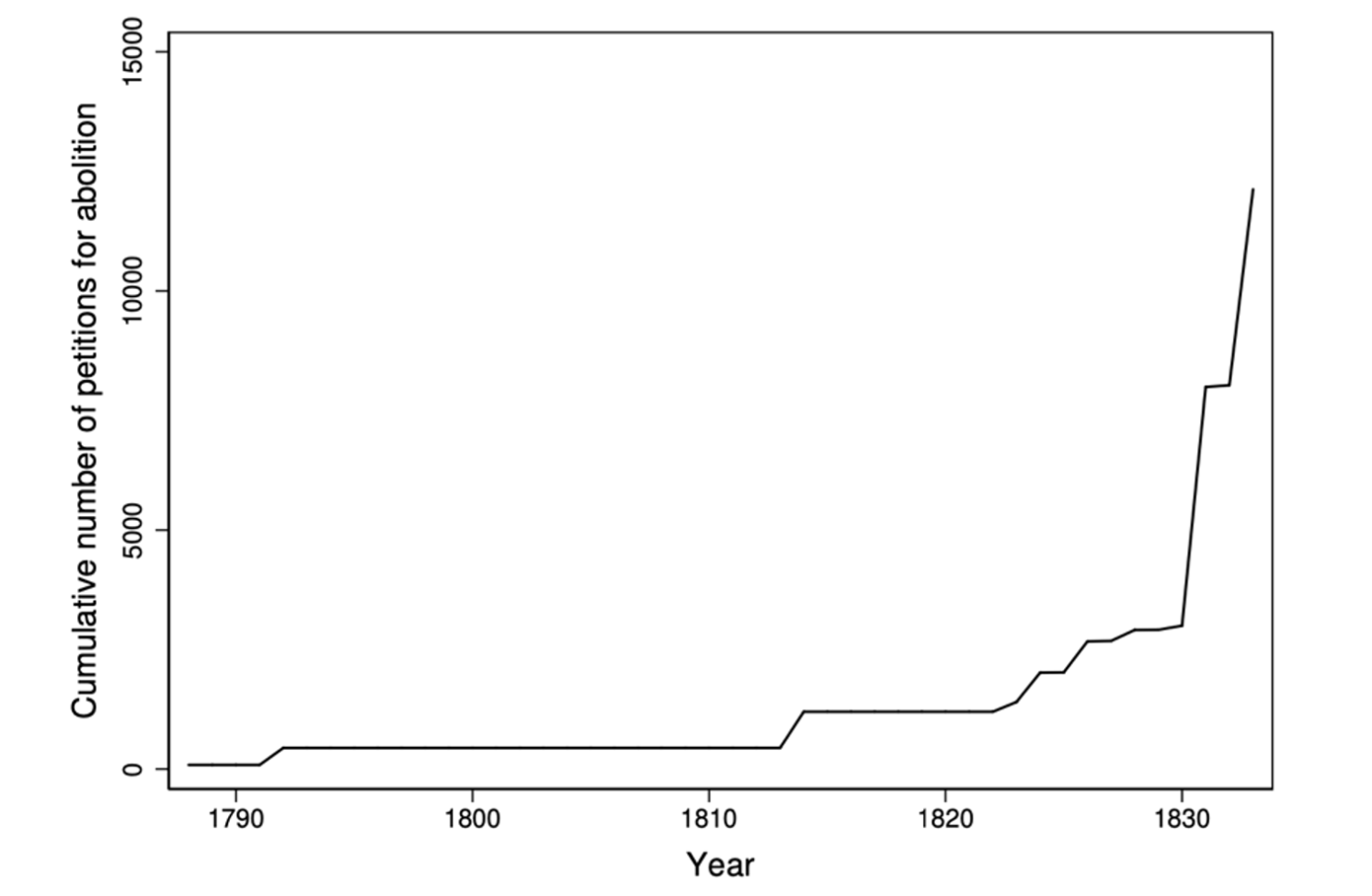
“An estimated 20% of all British men over 15 years of age had signed a petition for the abolition of slavery.”— Seymour Drescher, historian and professor (Drescher, 1982).
“Signatures in moral condemnation of the slave trade or, later, slavery, broke from the general pattern of private petitions for local 'improvement' bills.”— Richard Huzzey ("A Microhistory...", 2019).
After runaway slave James Somerset was about to be transported
from Britain to Jamaica, leading abolitionist Granville Sharp
represented Somerset in court against Somerset's captor, Charles
Stewart
(Cotter, 1994; Kelly, 2009).
Image: Granville Sharp the Abolitionist Rescuing a Slave (Hayllar, 1864).
“William Murray, 1st Earl of Mansfield, heard the case and produced a carefully worded ruling that held that masters could not send slaves out of England.”— Jason Kelly, professor in British History at Indiana University (Kelly, 2009).
“[Somerset's case was] as co-equal [as] the Declaration of Independence”— William Cotter, former president of Colby College (Cotter, 1994).
Olaudah Equiano, former slave turned abolitionist, published The Interesting Narrative of the Life of Olaudah Equiano, his memoir, pivotal to the movement.
Image: (Frontispiece
and Title Page from The Interesting Narrative of the Life of Olaudah
Equiano, 1794).
“Olaudah describes not only his ancestral customs, but his experiences of enslavement from kidnapping to the eventual purchase of his own freedom...Olaudah's life, legacy and the detail in which he describes his experience significantly drove the abolitionist movement.”— Khaleb Brooks, National Museums Liverpool (Brooks, 2022).
“Are they treated as men? Does not slavery itself depress the mind, and extinguish all its fire and noble sentiment?”— Olaudah Equiano in The Interesting Narrative of the Life of Olaudah Equiano, his memoir (Equiano, 1789).
“Let the polished and haughty European recollect that his ancestors were once, like the Africans, uncivilized, and even barbarous. Did Nature make them inferior to their sons? and should they too have been made slaves?”— Olaudah Equiano in his memoir (Equiano, 1789).
(Slaves Cutting the Sugar Cane, 1823).