Legacy
Reparations
Image: Political cartoon about the 20 million in reparations (Grant, 1837).
“All such Persons should be manumitted and set free, and that a reasonable Compensation should be made to the Persons hitherto entitled to the Services of such slaves.”— 1833 Slavery Abolition Act ("Slavery Abolition Act", 1833).
“If it should be found that they had been treated with cruelty, whether it was the intention of Government to withhold the remainder of that sum?”— Mr. Edward Baines, a member of Parliament ("Slave Compensation", 1837).
“As part of the compromise that helped to secure abolition, the British government agreed a generous compensation package of £20 million to slave-owners for the loss of their ‘property’.”— Michael Anson and Michael D. Bennett (Anson, 2022).
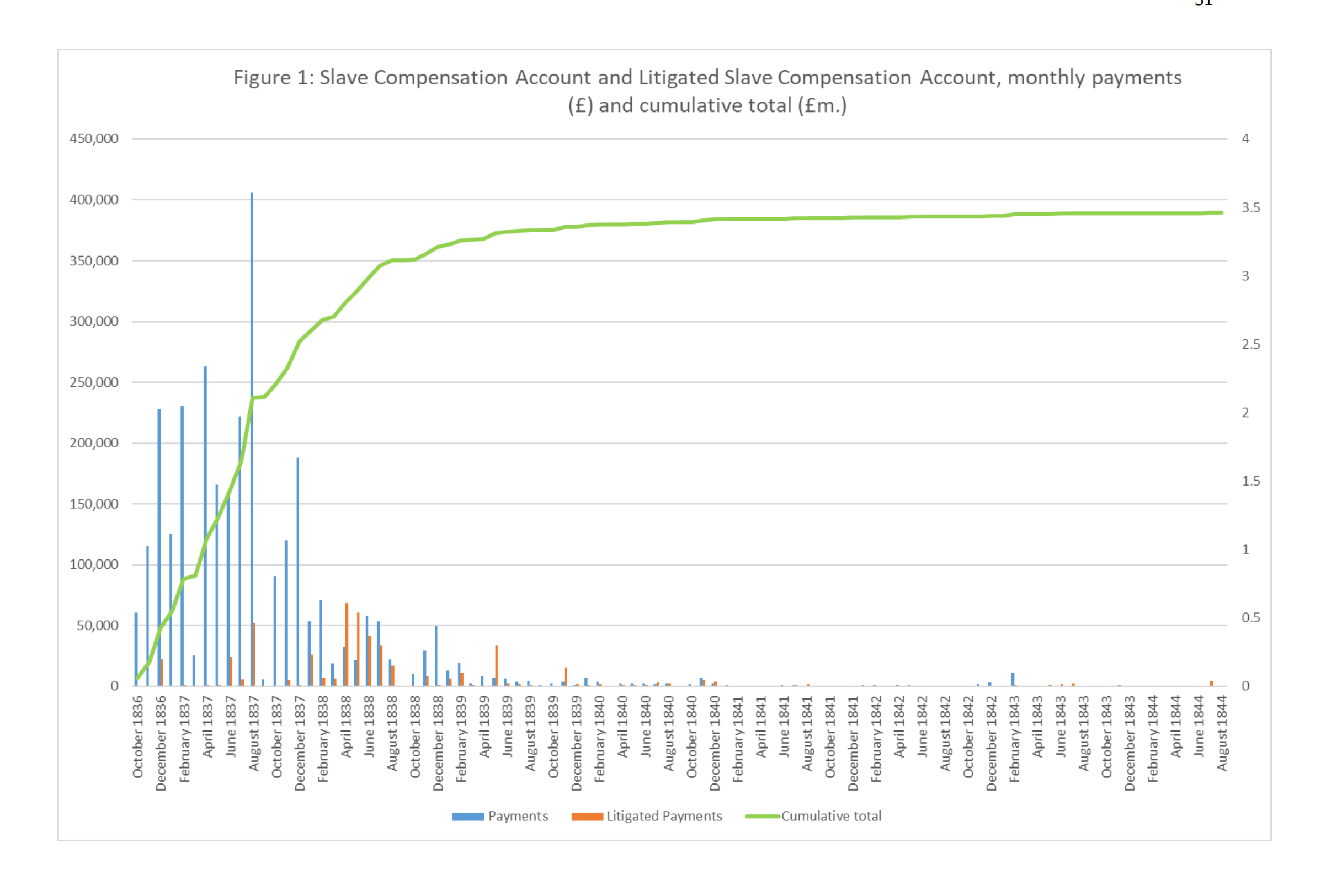
This was about 40% of Britain's annual spending budget, and £3.4 million was awarded as government stock for slave compensation (Milne, 2020; Anson, 2022).
Graph: (Anson,
2022).
Legend:
Cumulative payments (£ millions) Payments (£) Litigated payments (£)
“James Blair, awarded £83,530 in compensation for ownership of 1,508 people in British Guiana in August 1834.”— Emily Miller, Migration Museum (Miller, 2014).
“After 1834, British investment continued in places where slavery remained legal, like Cuba. In the 1840s, 20% of British sugar imports came from Cuba” (Shapiro, 2007).
Image: "Ten views in the island of Antigua in which are represented the process of sugar making, and the employment of the Negroes, in the field, boiling-house and distillery" (Clark, 1823).“The negroes of this and of all the British W. I. colonies have been 'emancipated.' Cuba on the other hand is still a slave country.”— Royal Gazette, published May 6, 1837 (Thome, 1837).
“The ways in which these debts were calculated and transferred to different government bonds and funds meant that the residue of these slavery payments was not cleared until 2015.”— National Archives ("The 1833 Abolition of Slavery Act and compensation claims", 2023).
(Slaves Cutting the Sugar Cane, 1823).